
Starting with a much higher necessity, on the part of the mother, but also of the fetus, of nutrients, pregnant will have to replace the daily diet in the following way.
| Compound | Unit of measurement | The unpregnant woman | Pregnant women |
|---|---|---|---|
| Protein | g | 45 | +30 |
| Carbohydrates | g | +5 - +6 | |
| Lipids | g | +50 - +60 | |
| Calories | kcal | 2100 | +300 |
| Calcium | mg | 800 | +400 |
| Iron | mg | 18 | +30 - +60 |
| Folic acid | mg | 0,4 | +0,4 |
| Ascorbic acid | mg | 60 | +20 |
In the course of pregnancy the woman grows on average weight with 12kg, this increase being linked to the weight of the fetus, placenta, amniotic fluid but also the increased amount of extracellular water and accumulation of adipose tissue. The plasma volume increases by about 40% (3800ml), decreases the number of red blood cells, increases the number of leukocytes and VSH. These changes are designed to increase the transport capacity of oxygen by about 18%. In pregnancy increases basal metabolism adapted to fetal needs. The heart rate increases slightly by 15-20 beats/minute and blood pressure decreases in the first quarter by 10-155mmHg. As we approach the term, it returns to normal. In pregnancy, the psyche can sometimes suffer affective deviations in pregnant behavior due to the particular hormonal factor compared to the pregnant woman, with a fear and distrust about the evolution of pregnancy.
The known vomiting and nausea and fainting states are occurring because progesterone causes decreased bowel and gastric movements that contribute to the digestion of food inside the digestive tract. The reduced intestinal motility given by progesterone favors the emergence of constipation.
The vagina receives an abundant amount of blood and thus the muscular coating acquires a purplish hue; Its vaginal secretions also end in a whitish color and tend to become more abundant in the first part of the pregnancy.
The uterus undergoes significant changes from the point of view of the structure by increasing its muscle, its walls relax with the evolution of pregnancy. These structural changes, especially represented by volume increase appear more prominently at the uterine body level. Its wall reaches 8 mm, normal size, approximately 25 mm at Week 12.
As a form, it varies directly in proportion to that of the placenta, as follows:
- Weeks 1-8 is Piriform
- 12-16, Glob
- 16-term, ovoid
The rise of the uterus in relation to the age of pregnancy is also closely related to the size of the fetus from that period:
- Initially belonging to the small basin, in the first two months it reaches the upper edge of the pubic simphize reaching the lower portion of the abdominal cavity.
- In the 3rd month it develops and a painful syndrome can occur, it dragging round ligaments.
- In the 5th month is located with the upper uterine pole is at the navel level
- The ninth month reaches the lower limit of the sternum where it remains up to the deadline
- At term the bottom of the uterus descends by about 2 fingers, with the descent of the fetal skull prepared for childbirth, and the pregnant remark an improvement in the genrale condition with easier breathing.
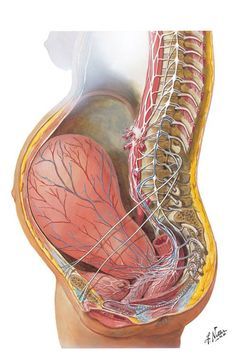
Section [Source]
Closed uterine cervix allows uterine confinement to the point of labor, an important role in this level with a gelatinous stopper that is a mechanical and immunological barrier that prevents the contact of amniotic megas with the vaginal environment.
The fallopian tube in this process retains its structure, showing a discreet change in the mucosa under the influence of the hormonal factor.
In the first trimester of pregnancy, the yellow body developing at the ovarian level instead of the ovulatory follicle plays a role in progesterone secretion that facilitates pregnancy evolution until, at the end of the fourth month, the placenta becomes fully mature, being able to takes on the important endocrine role. At this point the yellow body will turn around.


About Corneliu Zaharia
