
Bacteria are live micro-organisms, visible with the optical microscope, single-celled (consisting of only one cell), sexless (somatic cell and reproducing cell – simple division through scissiparity), haploids (with unique set of genes).
The morphofunctional unit of bacteria is the prokaryotic cell.
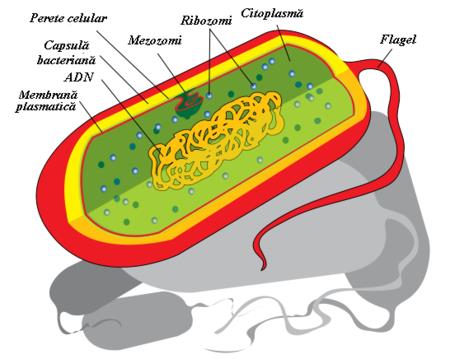
The components of the prokaryotic cell [Source]
The cell is the structural, functional and genetic base unit of all living organisms.
From structure point of view, the cell may be of the eukaryotic (or nucleic) type, or of the prokaryotic type (they have no true nucleus, that is, the genetic material is not delineated by the cytoplasm through a membrane). The main differences between prokaryotic and eukaryotic cells are displayed in the table below.
| The cell eukaryotes (gr, true, karyon "core, nucleus") | The prokaryotic cell (gr pro, before, karyon "core, nucleus") |
|---|---|
| Type of organisms: protesters, mushrooms, plants, animals | Type of organism: bacterium |
| Large dimensions (10 - 100μm) | Small dimensions (1 - 10μm) |
| The cell divides by mitosis or meiosis | Simple direct division (binary fission or sciziparity) |
| The nuclear device Nucleus nucleus, surrounded by nuclear membrane; - chromosomes 2n (diploid) or n (haploid), nucleol present, nuclear membrane present (concentrated DNA material) | Not a true core. The nucleotide consists of circular bicameral DNA, sometimes linear, placed freely in the cytoplasm. DNA is replicated in loops and stabilized by RNA and protein. Each loop is hyperspirational under the action of DNA gyrase and topoisomerase IV (found only in bacteria). On the DNA are synthesized enzymes (DNA-, RNA- polymerases); Lack of nuclear membrane. |
| The cytoplasmic membrane contains sterols | The cytoplasmic membrane has no sterol structure (except Mycoplasma) |
| Cytoplasm: - tubular organisms present: endoplasmic reticulum, mitochondria, internal Golgi internal reticulum, lysosomes - the ribosomes attached to the rugged endoplasmic reticulum are 80 S with 40 S and 60 S subunits | cytoplasm: - absent tubular organs - free ribosomes in the cytoplasm, are 70S with subunits of 30S and 50S - Particular organisms present: mesozomes, oxizomes, plasmids |
| Lack of the cell wall (if present, contains chitin or cellulose) | The presence of cell wall containing obligatory peptidoglycan |
| The presence of cellular organisms | The absence of cellular organisms, homogeneous, non-compartmental cytoplasm |
| Forms of resistance - do not exist | Forms of resistance - spawn |
Morphology of bacteria
The shape (spherical, rod, filamentous), the size (cell microorganisms are sizes 1 – 10 microns) andthe placement of bacteria (irregular piles, chains, terraces, palisades, diplo, isolated and in random positions) can be highlighted with the aid of the optical microscope, using the native preparation and the fixed and coloured preparation (smear), but the bacterial structure can be studied only in the electronic microscopy.

Fundamental forms to bacteria [Source]
Fundamental forms and types of settlement in bacteria (after Dumitru Buiuc 1992)
- a) spherical shape (cocci) – placed in piles or similar to grape clusters (e.g. Staphylococcus genus) in chains (e.g. Streptococcus genus), in short chains/diplo (e.g. Enterococcus genus) in diplo as two candle flames that unite through their bases (e.g. Streptococcus pneumoniae) in diplo as two coffee beans (e.g. Neisseria Gonorrhoeae), tetracocci (Tetracoccus), in packs of 8 individuals positioned symmetrically (Sarcina type);
- b) rod shape (bacilli) – placed isolated and in random positions between each other (Enterobacteriaceae), in chains (e.g., Bacillus anthracis) isolated or in groups (e.g. Mycobacterium tuberculosis), fusiform (ex: Bacillus fusiformis), grouped in pairs or in short chains (e.g. Klebsiella pneumoniae), in palisades, like the planks of a fence (diphtherimorph bacilli), or typically disposed in the form of Chinese capital letters or letters such as diphtheria bacilli (Corynebacterium diphteriae);
- c) intermediate shape between that of a coccus and a bacillus (Coccobacilli) – placed isolated or rarely present in irregular piles (e.g. Brucella genus), desposed in diplo or in short chains (e.g. Genus Haemophilus);
- d) spiral (incurved) form – with incomplete spire, a comma aspect (e.g.: Vibrio cholera), with 1-2 rigid spires (e.g. Spirillum).
Bacterial cell structure
.

Bacterial cell structure [Source]


About Corneliu Zaharia
