
The body’s defence against infections is carried out through non-specific and specific mechanisms that form together the immune response – the body’s reaction to contact with a foreign infectious agent (antigen).
1. The nonspecific defence is rapid, transitory and is identical regardless of the micro-organism type, being represented by:
A. Mucocutaneous Barrier: skin and mucous membranes (movements of the respiratory mucosa, gastric acid secretion, bactericidal substances in tears, local microbial flora are defence mechanisms)
B. Nonspecific humoral defense is represented by substances in different secretions (humoral factors):
- Lysozyme (present in tears, saliva, nasal secretions, plasma, breast milk);
- The Complement system with role in initiating inflammatory response,
- Cytokines (substances developed by lymphocytes and monocytes, with the role of mediation the organism’s response to infections) and interferons (cytokines with predominantly antiviral and anti-tumour action)
C. Cellular unspecified defence is represented by cells with a role in the destruction of micro-organisms:
- Granulocytes (neutrophils and eosinophils) and macrophages, with a role in phagocytosis and the destruction of germs.
- Natural Killer Cells (NK), with role especially in destroying viruses, but also of some bacteria and tumour cells.
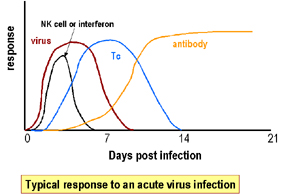
The typical response to an acute viral infection [Source]
2. Specific defense is called Immunity or Immune Response, it is performed differently, strictly specific depending on the type of microorganism by:
A) Specific humoral defense – represented by antibodies (immunoglobulins); antibodies are substances synthesized by activated B lymphocytes (when encountered with an antigen)
The antibody response of the body is primary and secondary. The primary response occurs at the first encounter between B lymphocytes and an antigen, producing IgM-like antibodies, acute infection indicators and persisting in the blood for a short time. Subsequently, IgM – like antibodies are replaced by those of the IgG type, old infection indicators, and which persist for a long time at high levels (titers) – the secondary response.
B) Cellular specific defense – is most important in viral infections and is performed by T lymphocytes (with cytotoxic-suppressor helper types). These cells play a role in stimulating B lymphocytes for antibody production, increasing the phagocytic phage capacity of macrophages, protecting against viral infections, etc.


About Corneliu Zaharia
